
Since 2005, the Mental Health Association of Maryland (MHAMD) has chaired the Maryland Mental Health and Criminal Justice Partnership (MHCJP). The MHCJP – which includes representatives from state agencies, local correctional facilities, the judiciary, advocacy organizations, providers and more – has worked over the past decade to improve services and break the cycle of rearrest and reincarceration for individuals with mental illness who become involved with the criminal justice system.
The implementation of Crisis Intervention Teams (CITs) in every jurisdiction across the state has been a primary MHCJP objective since the beginning. At its core, CIT is a partnership between law enforcement, behavioral health providers and advocates to assist and divert individuals in crisis, resulting in less lethal interventions, better outcomes, and increased safety for all involved. In recent years, efforts to expand the availability of these programs throughout Maryland have been helped by a CIT subcommittee of MHCJP which has, among other things, worked to coordinate efforts among local partners, assist in plan development, and bring law enforcement and behavioral health professionals together through a series of relationship-building forums. To date, eleven jurisdictions have implemented some form of CIT program, up from five only a year ago.
Last week our efforts received another huge boost. Along with our partners at the Behavioral Health Administration (BHA) and the Maryland Police and Correctional Training Commissions (PCTC), MHAMD organized a CIT Train the Trainer event led by Major Sam Cochran, a national expert in the field of crisis intervention. Maj. Cochran and his team from the University of Memphis CIT Center spent two days training a core group of local law enforcement and behavioral health partners on strategies for teaching de-escalation techniques and designing an effective curriculum, with a goal of building an expertise and capacity in Maryland that will allow for more regional and local CIT training. A key barrier to implementation in rural areas and smaller jurisdictions is an inability for law enforcement personnel to take time away from their duties to attend a CIT training in a distant part of the state. With this new training capacity, jurisdictions that are currently struggling to begin a CIT program will have access to training and to acquiring the skills required to successfully conduct future trainings themselves.

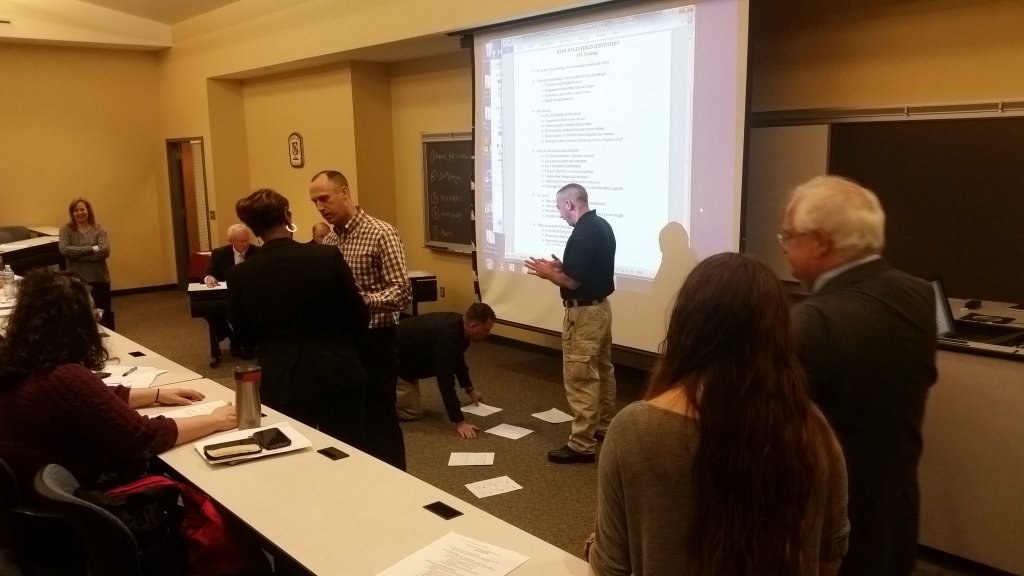
The full class of newly-trained trainers, and learning de-escalation training techniques through role playing.
MHAMD is proud to be a part of these efforts to improve the way communities respond to individuals in crisis. Anyone that would like more information on our efforts through MHCJP or the CIT Subcommittee can contact Dan Martin, MHAMD’s Director of Public Policy, at dmartin@mhamd.org